AlphaFold and the 2024 Chemistry Nobel
AI cracks a 50-year biology puzzle. AlphaFold predicts protein shapes from their sequences. It earned Demis Hassabis and John Jumper a share of the 2024 Nobel Prize in Chemistry.

Baker, Hassabis and Jumper, Nobel laureates 2024: Jennifer 8. Lee, CC BY-SA 4.0
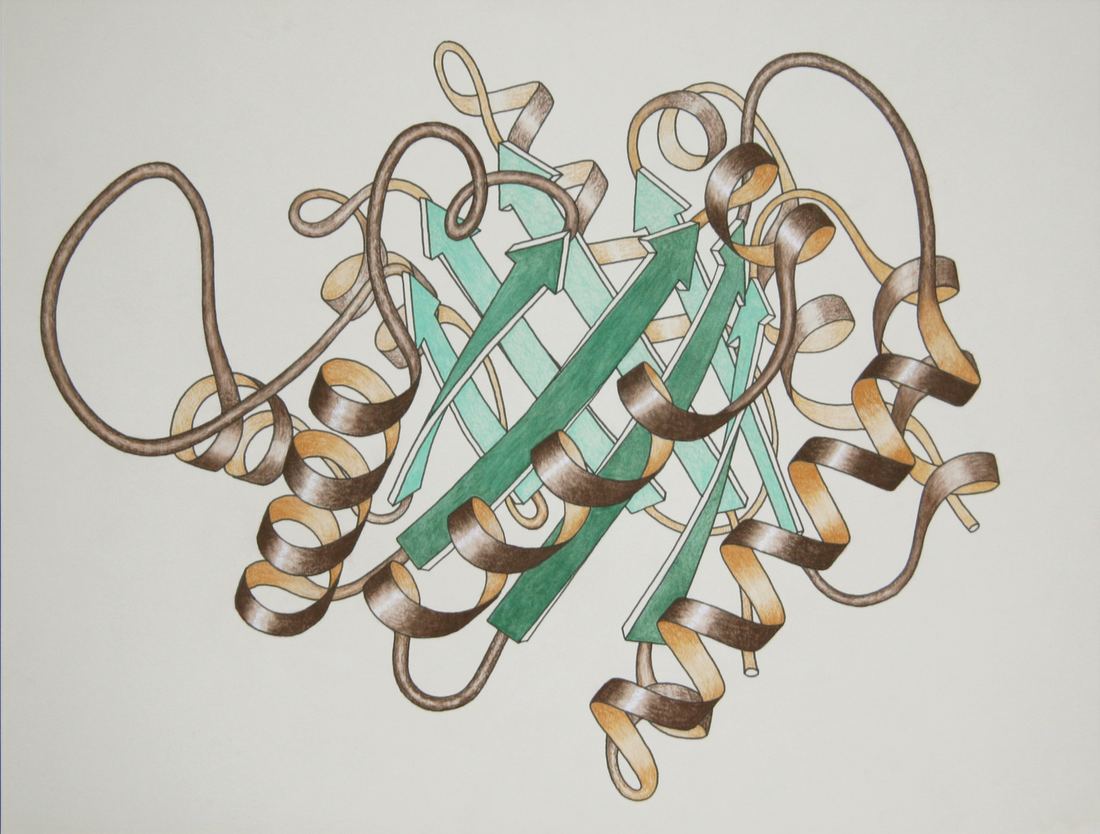
The protein folding problem
Proteins do most of the work inside living things. Each one is a chain of amino acids that folds into a precise three-dimensional shape, and that shape decides what the protein does. For decades scientists could read a protein's sequence far more easily than they could see its shape, which required slow and costly lab methods such as X-ray crystallography.
Predicting the fold from the sequence alone was one of biology's great open problems. Since 1994 a contest called CASP has tested prediction methods against structures that have been solved in the lab but not yet published.
Video: AlphaFold: The making of a scientific breakthrough (Google DeepMind), embedded from YouTube.
An AI solved a 50 year biology puzzle and won a Nobel Prize
DeepMind's AlphaFold predicted structures for over 200 million proteins; Hassabis and Jumper shared the 2024 Nobel Prize in Chemistry.
YouTube @StrawberryLemonadAI (launching soon). Photos in this Short: Human Oxy-Hemoglobin Protein.jpg - PDB code 2DN1 1.25 a resolution crystal structures of human (CC0) via Wikimedia Commons | Ribbon diagram of the DED.jpg - BQUB16-Oibanez (CC BY-SA 4.0) via Wikimedia Commons | Laboratory pipettes.jpg - J.N. Eskra (CC BY-SA 4.0) via Wikimedia Commons | Use of a Multichannel Pipette for High-Throughput Liquid Handling in a Biosafety Cabinet.jpg - Siduduziwe Nxumalo (CC BY-SA 4.0) via Wikimedia Commons | Demis Hassabis.jpg - Alain Herzog (CC BY-SA 4.0) via Wikime
What AlphaFold did
DeepMind, the London AI lab led by Demis Hassabis, entered CASP in 2018 with the first AlphaFold and placed first. In 2020 a redesigned system, AlphaFold 2, led by John Jumper, produced predictions that were often close to experimental accuracy. Organizers described it as a solution to a long-standing problem for many single proteins.
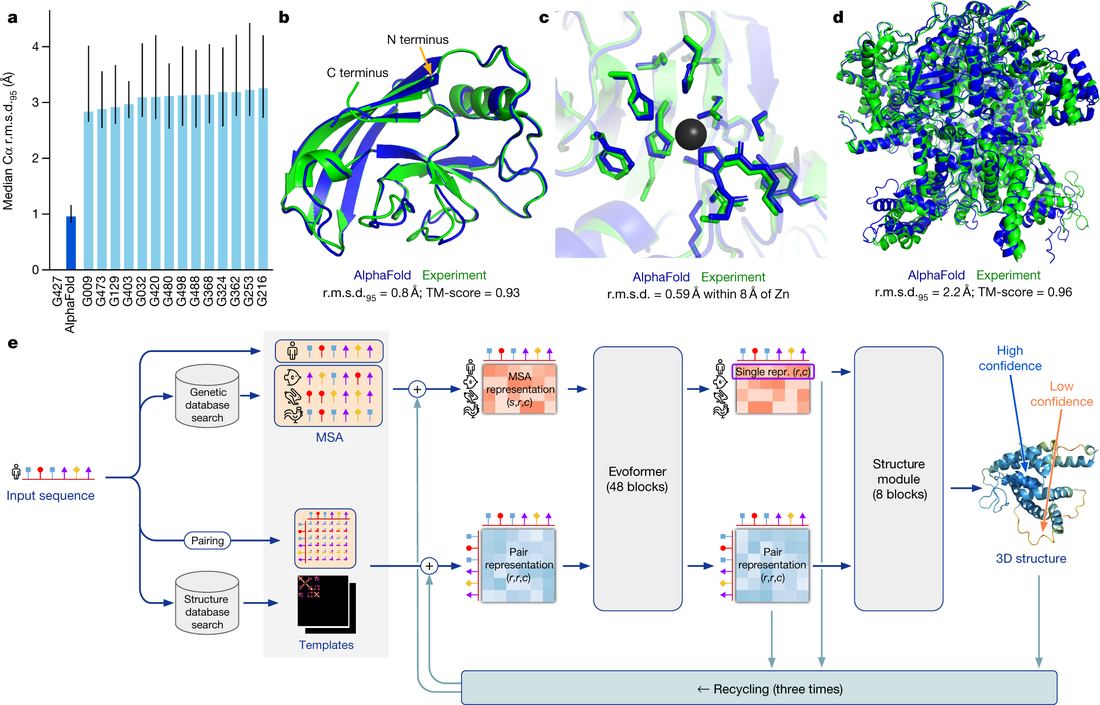
AlphaFold 2 is a deep learning system trained on known structures from the Protein Data Bank. It compares related sequences from many species to spot pairs of amino acids that tend to change together, a clue that they sit near each other, and it uses attention-based networks to refine a full 3D model.
A Nobel for computing and chemistry
In October 2024 the Royal Swedish Academy of Sciences awarded the Nobel Prize in Chemistry in two halves. One half went to David Baker of the University of Washington for computational protein design, building entirely new proteins. The other half went jointly to Hassabis and Jumper for protein structure prediction.
It was a striking year for AI at the Nobels. A day earlier, the physics prize honored John Hopfield and Geoffrey Hinton for foundational work on neural networks.
Why it matters to everyone
DeepMind and the European Bioinformatics Institute released a free database of AlphaFold predictions, which grew to cover over 200 million proteins, nearly every one known to science. Researchers use it to study diseases, design enzymes and plan experiments faster. A later version, AlphaFold 3, announced in 2024, extends predictions to how proteins interact with DNA, RNA and small molecules. Predictions still need checking in the lab, but they have changed where biologists start.
- NobelPrize.org: Press release, The Nobel Prize in Chemistry 2024
- NobelPrize.org: The Nobel Prize in Chemistry 2024, Popular information
- Google DeepMind: AlphaFold reveals the structure of the protein universe
- AlphaFold Protein Structure Database: About
Facts on this page were checked against these sources.
- Baker, Hassabis and Jumper, Nobel laureates 2024: Jennifer 8. Lee, CC BY-SA 4.0
- A protein drawn as a ribbon, 1981: Jane Richardson, CC BY 3.0
- AlphaFold results from the 2021 paper: John Jumper et al, CC BY 4.0
- Short photos: Human Oxy-Hemoglobin Protein.jpg - PDB code 2DN1 1.25 a resolution crystal structures of human (CC0) via Wikimedia Commons | Ribbon diagram of the DED.jpg - BQUB16-Oibanez (CC BY-SA 4.0) via Wikimedia Commons | Laboratory pipettes.jpg - J.N. Eskra (CC BY-SA 4.0) via Wikimedia Commons | Use of a Multichannel Pipette for High-Throughput Liquid Handling in a Biosafety Cabinet.jpg - Siduduziwe Nxumalo (CC BY-SA 4.0) via Wikimedia Commons | Demis Hassabis.jpg - Alain Herzog (CC BY-SA 4.0) via Wikimedia Commons | TMEM253 AlphaFold Predicted Structure.jpg - Liu02511 (CC0) via Wikimedia Commons | Server Room (22397102849).jpg - Carl Lender from Sunrise, USA (CC BY 2.0) via Wikimedia Commons | Demis Hassabis at the 2024 Nobel Lectures 2.jpg - Jay Dixit (CC BY-SA 4.0) via Wikimedia Commons
Text written by Strawberry Lemonadai.
← ChatGPT's Launch and Record GrowthNeural Networks Explained →